For more information, contact us on [email protected].
Renewables for Nature
The Renewables for Nature (REN) Coalition brings together energy companies and IUCN member organisations to ensure the global shift to wind and solar power is nature-positive. By promoting spatial planning, cumulative impact assessment, and responsible sourcing of materials, the REN Coalition equips governments, companies, and investors with guidance to align renewable energy development with biodiversity conservation and climate goals.

Achieving a climate-resilient future, in accordance with the Paris Agreement’s 1.5°C target and the Sustainable Development Goals (SDGs), requires rapid, sustained and far-reaching transformations in energy, land-use, infrastructure and industrial systems. Large-scale expansion of renewable energy can play a critical role in meeting the world’s growing energy demands and in the fight against climate change. However, even ‘clean’ energy sources can have significant unintended impacts to nature, if not properly planned and managed.
IUCN recognises the critical need to support the global transition to renewable energy in a way that mitigates biodiversity impacts and contributes to conservation. This sustainable transition is essential to achieving both global climate and nature goals. Success depends on the active support of decision-makers at every stage of planning and implementation.
IUCN is partnering with energy suppliers to promote the application of the mitigation hierarchy and best available measures to reduce biodiversity impacts associated with solar and wind power projects.
Phase 1
In 2021, IUCN partnered with the EDF Group, EDP and Shell to promote the application of the mitigation hierarchy and best available measures to mitigate biodiversity impacts associated with wind and solar power development. Phase 1 was carried out with The Biodiversity Consultancy and has involved BirdLife International, Fauna & Flora International, The Nature Conservancy, and the Wildlife Conservation Society. As a result of the first phase of this collaboration, IUCN and The Biodiversity Consultancy developed guidelines for project developers on mitigating biodiversity impacts associated with solar and wind energy development.
IUCN and The Biodiversity Consultancy have joined forces. The project aims to identify criteria and tools for selecting the most optimal locations for solar and wind energy development. It will also explore how to minimise impacts in the responsible production of raw materials used in renewable energy components.
Phase 2
Since 2022, IUCN has continued to partner with The Biodiversity Consultancy and collaborate with key partners, including BirdLife, Fauna&Flora, Wildlife Conservation Society, The Nature Conservancy, and five energy companies – EDF, ENI, Equinor, Shell and TotalEnergies.
Phase 2 has focused on three key objectives:
- To promote the integration of cumulative impact assessments in renewable energy developments
- To promote the concept of and tools for spatial planning, to identify suitable areas for renewable energy infrastructure and generation
- To explore support and stronger demand for more responsibly sourced raw materials necessary to promote renewable energy components
| Deliverables | Goal | Target Audience | Scope of Work |
| Cumulative impacts assessment guidance | promote the integration of cumulative impact assessments in renewable energy developments | policy makers, developers and investors | aim at explaining the importance of considering cumulative impacts and outline practical approaches to understand and address them |
| Biodiversity enhancement guidance | understand the positive contributions a company can make both as part of their legal requirements and beyond to enhance biodiversity following best available practices | developers and regulators | aim to provide evidence-based guidelines for wind and solar energy project biodiversity enhancement and restoration best practices |
| Responsible sourcing scoping paper | support a stronger demand for more responsibly sourced raw materials used in renewable energy development | renewable energy companies, investors and financial sector | provide guidance on the biodiversity risks and opportunities associated with the extraction of metals and minerals needed for wind and solar development |
| Spatial planning technical note | promote the identification of suitable areas for renewables energy infrastructure and generation through spatial planning | policymakers, developers and investors | clarify the role of different types of spatial plans, assessments and other multi-use frameworks and planning/assessment tools |
IUCN hosted a series of webinars to present new guidance on the renewable industry’s role in achieving nature goals. The three webinars – on 6, 13 and 20 March 2025 – were designed to help solar and wind developers, regulators, government officials, and local communities achieve their low-carbon aspirations, while safeguarding important landscapes and biodiversity. These webinars attracted an audience of over 1,000 professionals working at the interface of biodiversity and wind and solar energy. They are publicly available to watch on demand through the following links:
Session 1: Cumulative Impact Assessment and Spatial Planning
Session 2: Biodiversity Enhancement
Session 3: Responsible Sourcing and Biodiversity
Opportunities
Initial discussions regarding a possible Renewables for Nature Phase 3 occurred in late 2024, with a milestone of the IUCN World Conservation Congress in Abu Dhabi on 9-15th October 2025 identified for an official launch. The intention is to convene a larger number of stakeholders and structure the work around multiple activities, thus providing an acceleration in the pace at which we deliver knowledge and tools needed by the key actors in the industry, governments and financial sectors.
The priorities for Phase 3 are:
- Support a robust application of cumulative impact assessment and strategic spatial planning for the global transition towards renewable energy as a key component of delivering nature positive contributions.
- Support delivery of quantitative methodologies to demonstrate nature positive contributions from the renewable energy sector.
- Support implementation of sustainable sourcing of raw materials necessary to produce renewable energy components.

External stories:
Enhanced guidance with IUCN on mitigating biodiversity impacts in solar and wind energy development - The Biodiversity Consultancy
Featured Content

News
06 Oct, 2025
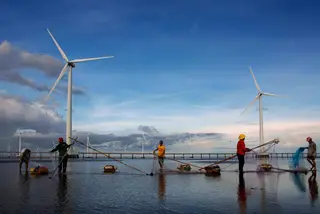
As the global community accelerates toward renewable energy expansion, experts and policymakers gathered at the 2025 World Coastal Forum in China on September 25, to explore how renewable energy…

Story
17 Sep, 2025
On September 9, at the opening ceremony of the 8th Conference on Wind Energy and Wildlife Impacts in Montpellier, France, Rachel Asante-Owusu represented IUCN with a powerful intervention.
Story
24 Feb, 2025
The three webinars – on 6, 13, and 20 March – will help solar and wind developers, regulators, government officials, and local communities achieve their low-carbon aspirations, while safeguarding…

Jointly published
2025
The key aim of this report is to outline how developers can start to act on supply chain biodiversity impacts by improving traceability and sourcing practices through. It is…

Jointly published
2024
The key aim of this guidance is to reframe cumulative impact assessment (CIA) to help support biodiversity conservation and the achievement of global biodiversity goals (alongside climate and…
Grey literature
2024
This technical note focuses on spatial planning for wind and solar development with respect to biodiversity. It is intended primarily for government planners responsible for the…
Jointly published
2024
The need to transition to a lower carbon, naturesafe renewable energy-based economy is more urgent than ever. This report provides an overview of potential opportunities for biodiversity…
Publication
2021
Achieving a climate-resilient future requires rapid, sustained and far-reaching transformations in energy, land-use, infrastructure and industrial systems. Large-scale expansion of renewable energy…

Grey literature
2021
This document provides brief practical guidance on early risk screening for offshore wind projects. It outlines how to identify and avoid areas of high biodiversity sensitivity, based on the IUCN/TBC…