IUCN launches new report on agriculture and biodiversity in the Mediterranean
The report reveals that at least 28% of the species assessed are affected by unsustainable agricultural practices.
Jornadas 2025 Agricultura, ganadería y biodiversidad
Photo: UICN Med
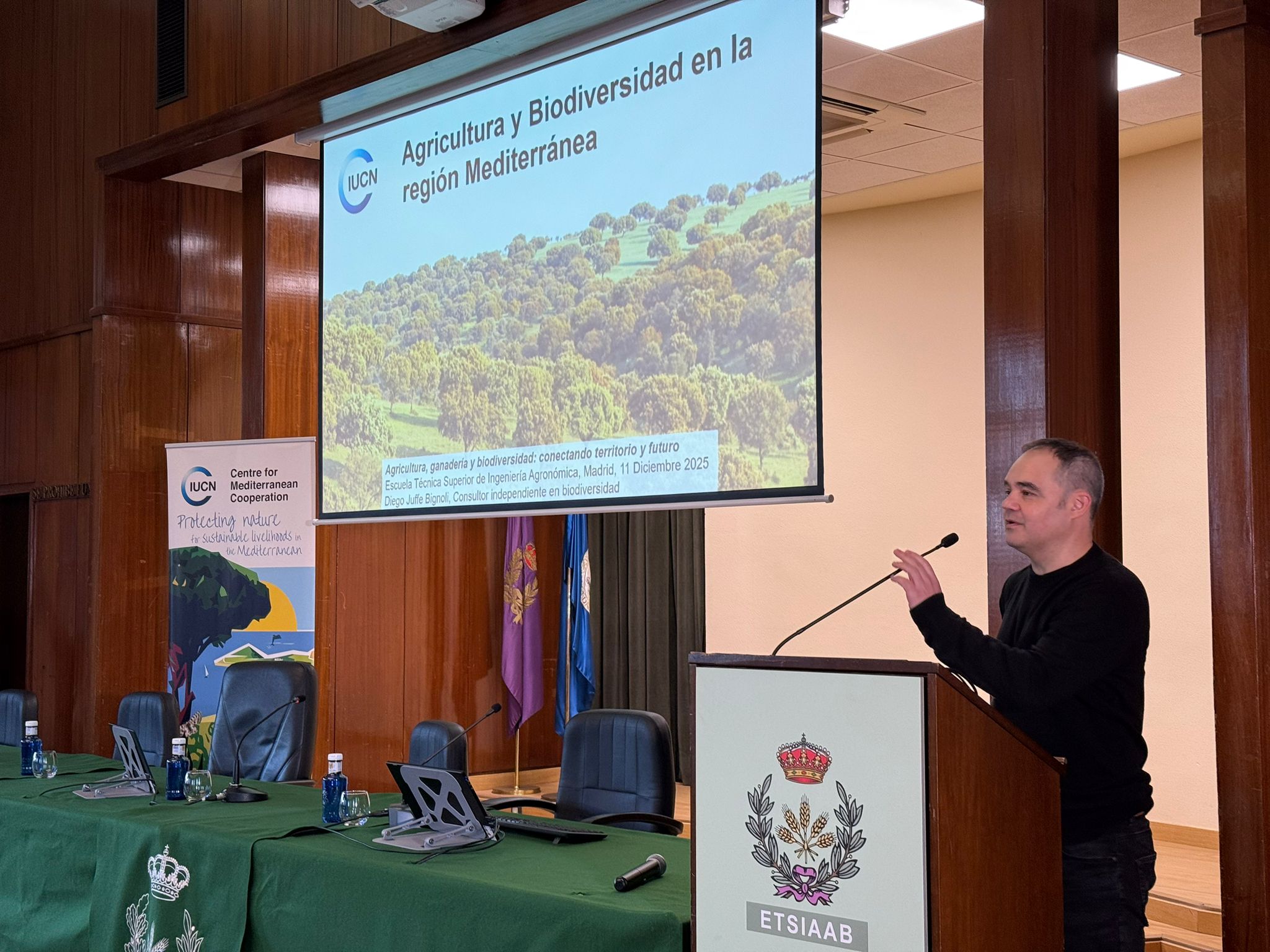
Photo: UICN Med

Mesa con todas las principales organizaciones agrarias en España
Photo: UICN Med

María Jesús Rodríguez de Sancho, MITECO
Photo: UICN Med

Maher Mahjoub en jornada Agricultura, ganadería y biodiversidad, Madrid 2025
Photo: UICN Med

The Centre for Mediterranean Cooperation of the International Union for Conservation of Nature (IUCN Med) presented today in Madrid a new report, Biodiversity and Agriculture in the Mediterranean Region: A Species Conservation Perspective, which warns of the growing threat posed by unsustainable agricultural practices to Mediterranean biodiversity and, at the same time, shows that well-managed agriculture can become a key ally for conservation.
The publication was unveiled at a conference held at the Higher Technical School of Agricultural, Food and Biosystems Engineering (ETSIAAB) of the Polytechnic University of Madrid, organized by IUCN Med together with the Spanish Ministry for Ecological Transition and the Demographic Challenge (MITECO), with the aim of highlighting practices in the agricultural and livestock sector that are compatible with the conservation of biodiversity, and strengthening the link between science, policy and rural reality.
The report, which analyzes the threats and suitable habitats for all Mediterranean species recorded in the IUCN Red List database, reveals that at least 28% of the assessed species are affected by unsustainable agricultural practices, such as monoculture, excessive use of pesticides and fertilizers, and overgrazing. These pressures lead to habitat loss and degradation, impacting birds, mammals, arthropods, plants, and other groups essential to the functioning of ecosystems.
However, the research also highlights that 18% of Mediterranean species depend on agricultural landscapes for survival, especially those managed in a traditional, diverse, and mosaic way. These agricultural landscapes constitute important habitats for numerous species. Certain species thrive specifically in agricultural habitats, such as the Red-legged Partridge in olive groves or the Black-eared Wheatear in landscapes dominated by olive trees.
“The Mediterranean is a biodiversity hotspot and a landscape shaped by agriculture over millennia. However, today we face the urgent need to balance food production with nature conservation. Integrating biodiversity into agriculture is not only an ecological necessity, but also an economic and social opportunity for rural communities,” says Maher Mahjoub, Director of IUCN Med.
Urgent actions in critical areas
Approximately 82% of the Mediterranean region's land area is dedicated to some form of agricultural activity. Agricultural habitats were identified as suitable for 18% of species, and for 2% they are habitats of major importance. Using the Species Threat Reduction and Restoration (STAR) metric—a global tool for assessing the potential benefits of reducing threats to species—for the first time at a regional scale, the recent IUCN study identifies priority areas such as southern Spain, Greece, Türkiye, and parts of North Africa, where improvements in agricultural practices could drastically reduce the risk of species extinction.
Mercedes Muñoz Cañas, Coordinator of the Nature Conservation and Food Systems program at IUCN Med and co-author of the IUCN report presented in Madrid, points out: “Sustainable agricultural practices reduce threats to many species while promoting food production and ecosystem resilience, even improving biodiversity. We want to combine perspectives, connect scientific evidence with the voices of the people on the ground, and, above all, identify realistic proposals that benefit both the sector and nature”.
IUCN Red List in the Mediterranean
The new report explores the relationship between species conservation and agriculture by reviewing the conservation status, threats, and habitats of species assessed on the IUCN Red List in the Mediterranean, and the role of agriculture as both a threat and habitat for these species. According to the assessment, 26% of the more than 4,400 species assessed in the Mediterranean region are threatened with extinction, a figure that rises to 50% for freshwater species and to 38% for Crop Wild Relatives, which are crucial for future food security.
Political Appeal for the Mediterranean Region
The report concludes by urging governments and agri-food stakeholders to integrate biodiversity objectives into their agricultural policies. In the EU, this means strengthening the Common Agricultural Policy and implementing the Nature Restoration Regulation; in North Africa, it means aligning with the Kunming-Montreal Global Biodiversity Framework.
The meeting held in Madrid, entitled ‘Agriculture, Livestock and Biodiversity: Connecting Territory and Future,’ brought together scientists, representatives from various ministries, civil society, the four major agricultural professional organizations, and the private sector to foster constructive dialogue with the agricultural and livestock sector and explore policies to support the sector in meeting the challenge of producing food for a growing population. The event was opened by María Jesús Rodríguez de Sancho, Director General of Biodiversity, Forests and Desertification at the Ministry for Ecological Transition and the Demographic Challenge (MITECO).
Access to the publication: Biodiversity and agriculture in the Mediterranean region | IUCN Library System
Access to agenda


The 30th Conference of the Parties to the United Nation Framework Convention of Climate Change (…

Victoria Falls, Zimbabwe, 24 July 2025 — The Indo-Burma Ramsar Regional Initiative (IBRRI)…

World Wetlands Day is celebrated annually on 2 February. To celebrate this year’s theme of “…