Coastal restoration training convenes Mediterranean MPA managers in Cabo de Gata
A dynamic training has taken place these days with learnings coming from eight different countries in the Mediterranean.
Photo: Sonsoles San Roman
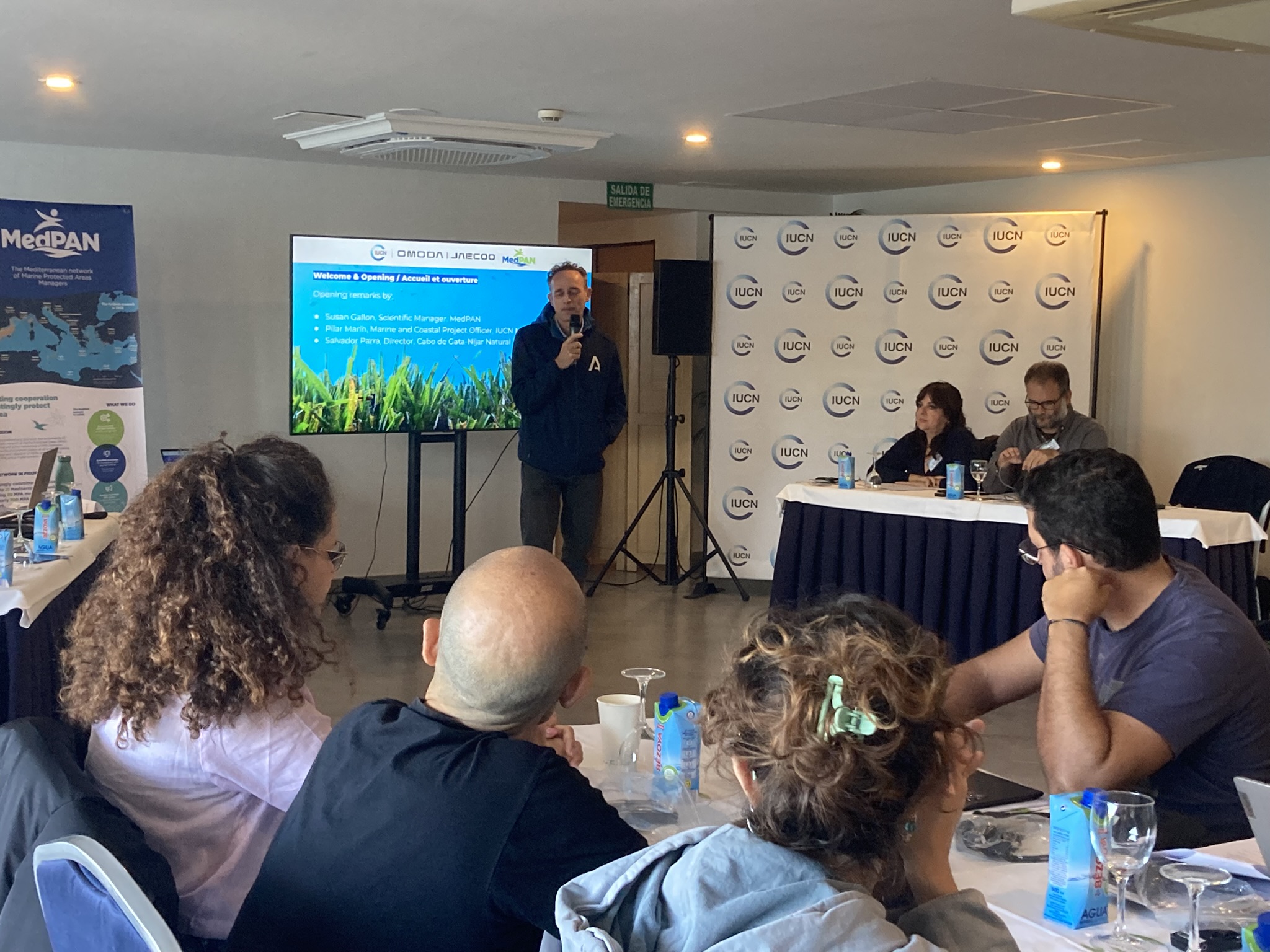
Photo: Sonsoles San Roman

Photo: Sonsoles San Roman

MPA managers discussing restoration in Cabo de Gata, November 2025
Photo: Sonsoles San Roman

Photo: Sonsoles San Roman

Photo: Sonsoles San Roman

Photo: Sonsoles San Roman

Kindly hosted by the multidisciplinary team engaged in the management of the Andalusian Cabo de Gata-Níjar Natural Park (Spain) and co-organized by the IUCN Centre for Mediterranean Cooperation and MedPAN, the restoration was the driver focusing the debate.
The training in Cabo de Gata-Níjar Natural Park, a Biosphere Reserve, UNESCO Geopark, Special Protection Area for Birds and part of the Natura2000 network, has assembled for four days key experts and managers from the protected area together with MPA peers and practitioners from Albania, Croatia, Cyprus, France, Italy, Lebanon, Spain and Tunisia. Supported by the REST-COAST and Cherish the Nature Spain projects, participants learned and exchanged about how to build strong restoration plans which can actively contribute to reaching international commitments, such as the 30x30 Target, efficiently and smartly. Additionally, for participants from EU countries this training is very timely given the entry into force of the EU Nature Restoration Regulation, as MPAs can contribute to the preparation of National Restoration Plans.
Insights from participants included reflections on the challenges posed by climate change and extreme events to restoration efforts, and the need to plan with a long-term and adaptative view. Considering different scientific and social scenarios as a baseline, appropriate protected area management plans in consensus with and promoting the engagement of local stakeholders can facilitate the monitoring of particular species’ indicators and assist in their conservation, management, and restoration. Ecological connectivity in the marine realm was also discussed, to improve the efficiency of restoration measures at a higher national and Mediterranean scales, keeping in mind potential upscaling of restoration actions.
The training also included sessions on the practical management of Cabo de Gata Natural Park, the science behind its natural assets and information about historical and present uses of the different zones that compose the park, made of volcanic beaches, fossil reefs, sandy beaches and some of the best conserved Posidonia seagrass meadows in the Mediterranean. With the active contribution of Junta de Andalucia, Hombre y Territorio (HyT), scuba divers, senior scientists and public sector representatives, participants had the opportunity to learn in situ how eco-moorings work and engage in a marine litter data collection using a monitoring protocol exercise which also fosters citizen science.
With a Mediterranean mutual learning objective, all the activities were held in English and French and addressed key aspects to consider when restoring coastal and marine areas, including biodiversity monitoring, stakeholders' engagement and policy frameworks. To complete the training, the last day was devoted to exploring and discussing financing and supporting mechanisms towards restoration using REST-COAST project outcomes. Lastly, participants had the opportunity to learn from several IUCN cases of private sector engaged in conservation activities.
An IUCN Med team collaborated in the running of the activities and contributed through lessons learned from the REST-COAST H2020 project on restoration policy and governance at various scales. Moreover, the IUCN Green List of Protected and Conserved Areas' standard was presented to provide guidance and recommendations to enhance restoration. Additionally, the GreenList4MMPAs (Green List for Mediterranean Marine Protected Areas) Interreg Euro-MED project was presented. This project aims to facilitate the adoption of the Green List by marine protected areas with the goal of enhancing the effectiveness and equity of marine protected and conserved areas management in the Mediterranean Sea.
IUCN Med helped coordinate this training with the support of the Chery Group - Cherish the Nature programme aiming at assisting the conservation, restoration and sustainable management of over 10 million hectares of ecosystems worldwide, working for passive restoration of seagrass meadows in Andalusia together with OMODA-JAECOO.
We thank MedPAN for actively organizing and animating discussions related to restoration among the network of MPA managers. Participants agreed on the need to organize further capacity building actions, to benefit from the knowledge and experience stemming of current practices and support realistic, strategic and ambitious passive and active restoration and conservation plans in their own areas and together, for the whole Mediterranean. Results from this training will be used to feed current restoration developments.
The participation of a Saudi Delegation of protected area managers in the training coordinated by IUCN opened the door to further visions and discussions related to geoparks and the management of arid areas in Andalusia.
We feel proud to have taken part in this meaningful exchange and example of Mediterranean cooperation across countries and sectors, bringing together science, practice and policy for better restoration.
We invite you to visit our photo gallery and key findings from our REST-COAST results.
👉 REST-COAST recommendations to strengthen 𝗰𝗼𝗮𝘀𝘁𝗮𝗹 𝗿𝗲𝘀𝘁𝗼𝗿𝗮𝘁𝗶𝗼𝗻 in policy frameworks including the NRR and the Paris Agreement: https://rest-coast.eu/media-center/policy-briefs
👉 Stakeholder Engagement - Policy and practice brief: https://doi.org/10.36333/rs14
More about us: Marine Biodiversity and Blue Economy | IUCN


The 30th Conference of the Parties to the United Nation Framework Convention of Climate Change (…

Victoria Falls, Zimbabwe, 24 July 2025 — The Indo-Burma Ramsar Regional Initiative (IBRRI)…

World Wetlands Day is celebrated annually on 2 February. To celebrate this year’s theme of “…